
Your account settings in Pyron sit in two places: the user menu in the header, and your security page. Between them you control how the app looks, sign out, and set up the extra checks that protect your account.
Your profile
Pyron identifies you by the email address you sign in with. Your name, email and role belong to your account, which your organisation's administrators set up and maintain. To change your name or email address, ask an administrator to update your account for you — the same goes for your role and permissions, which decide what you can see and do.
Everything you can adjust yourself lives in the user menu. Open it from the round avatar at the top-right of the header, labelled "User menu", to switch between light and dark appearance, change how compact the interface is, open your security settings, and sign out.
Changing your password
You change your password from the sign-in screen rather than from inside the app. Choose the forgot-your-password option, enter your email address, and Pyron sends a reset link to that address. Open the link and set a new password. The signing in guide walks through the whole flow.
If you cannot sign in at all — for example, because you have lost access to your email — your administrator can help you back in.
Multi-factor authentication
Multi-factor authentication (MFA) adds a second step to signing in: after your password, you confirm a code or a device that only you have. Someone who learns your password still cannot reach your account without that second factor.
If your organisation requires two-factor authentication, you are asked to set up at least one method before you can continue.
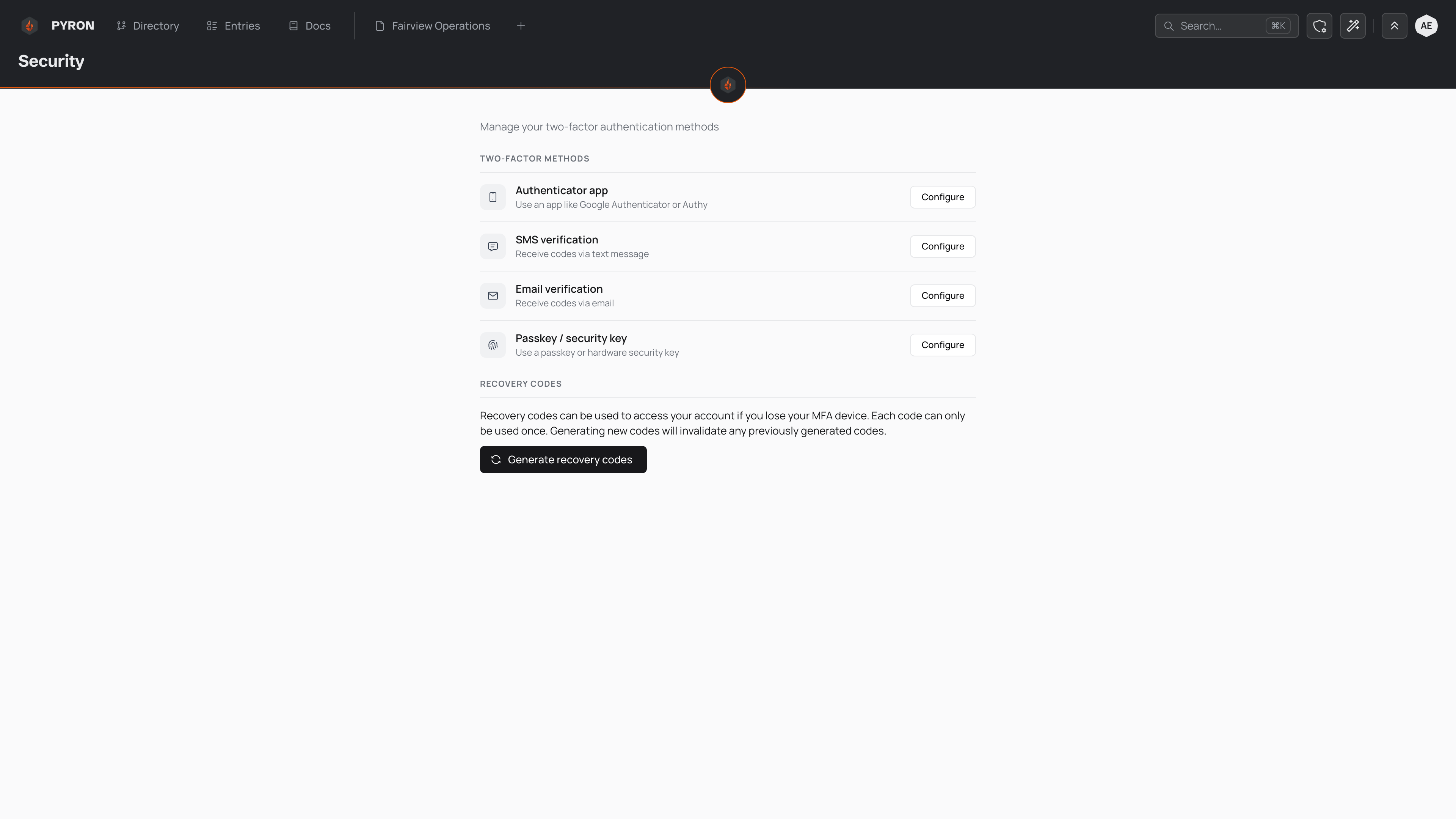
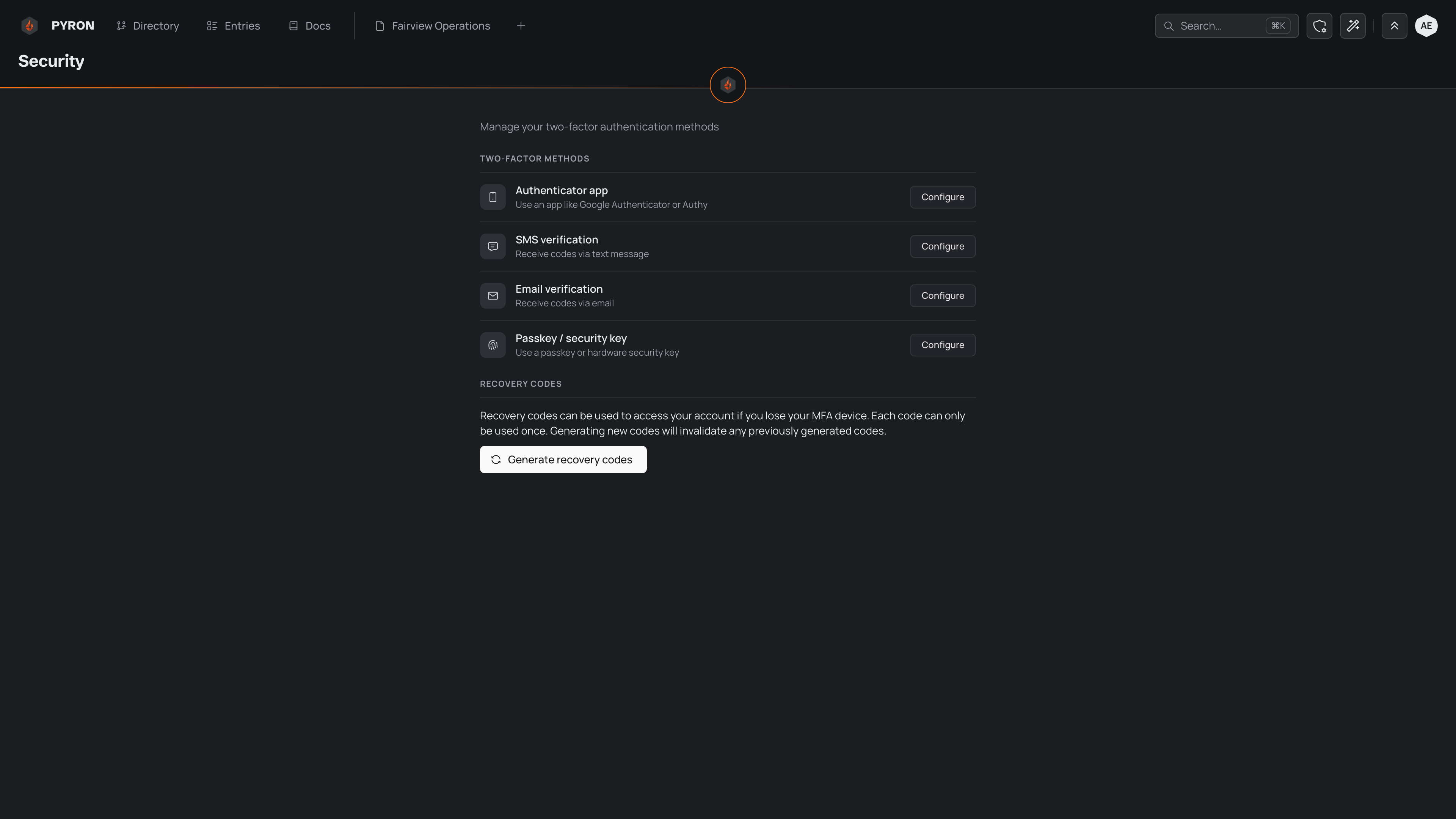
You manage your methods on your security page, which you reach from the user menu. It lists the second-factor options your organisation makes available:
- Authenticator app — use an app such as Google Authenticator or Authy.
- SMS verification — receive codes by text message.
- Email verification — receive codes by email.
- Passkey / security key — use a passkey or a hardware security key.
To turn one on, select "Configure" next to it and follow the prompts. Once a method is active, the page marks it as set up and you can remove it from the same place. For step-by-step setup of each option, see multi-factor authentication methods.
Recovery codes
Recovery codes let you get back into your account if you lose access to your usual second factor. Generate a set from the recovery codes section, then store them somewhere safe and private. Each code works once.
Use "Generate recovery codes" to create your set whenever you need one.