
An inbound API key lets a system you run — a partner's platform, a device in the field, a script on your own servers — call into Pyron without a person signing in. Each key acts as a service account: a stand-in identity whose roles decide what a caller holding the key can reach, most often to trigger an automation. You issue a key per integration, hand over its secret once, and revoke it the day that integration ends.
Issuing a key
Inbound keys live in Setup, on the Integrations page. Open the Inbound tab to see the keys your organisation has issued; the Outbound tab beside it handles the reverse direction — the connections Pyron's own automations call out through.
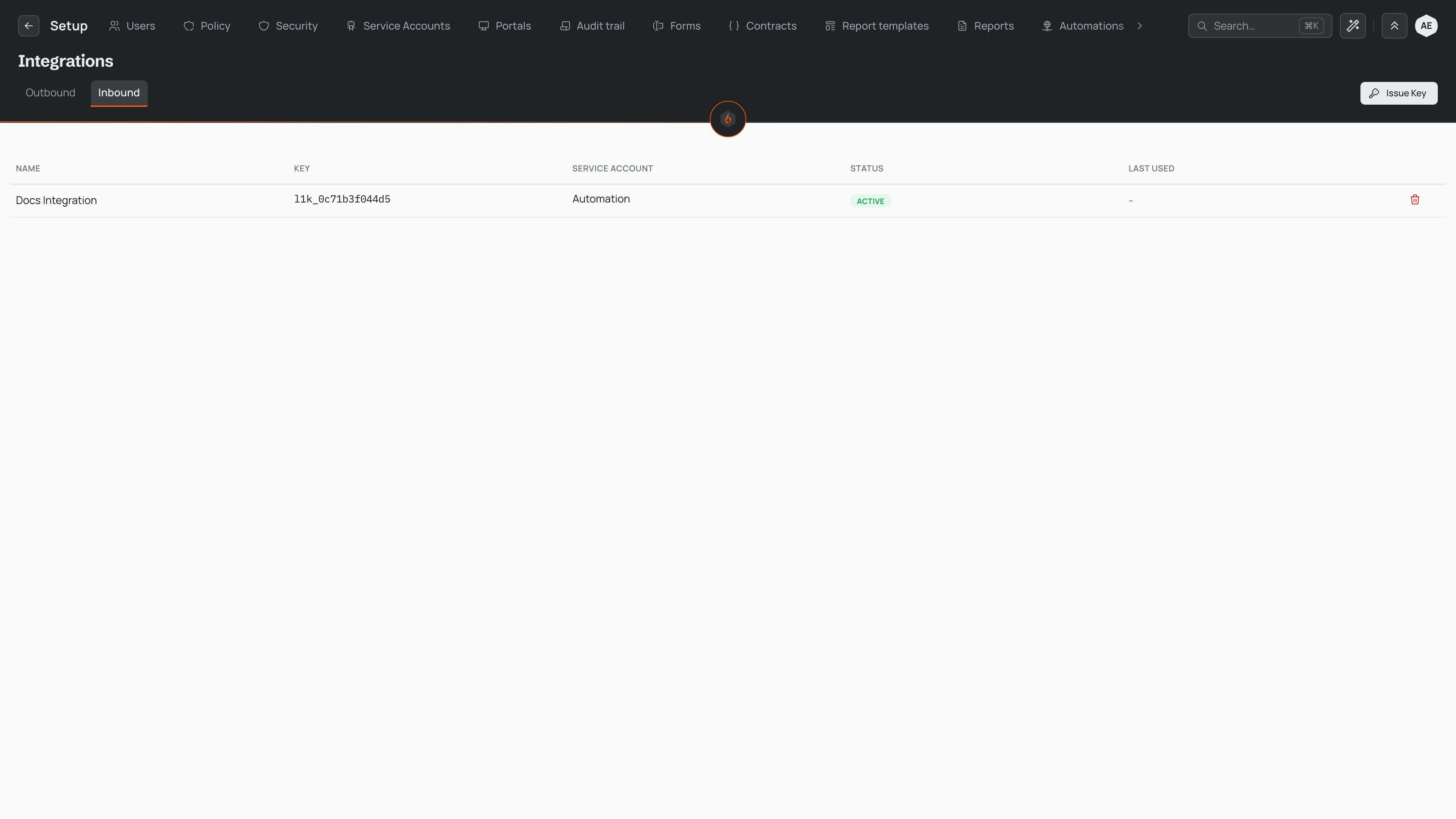
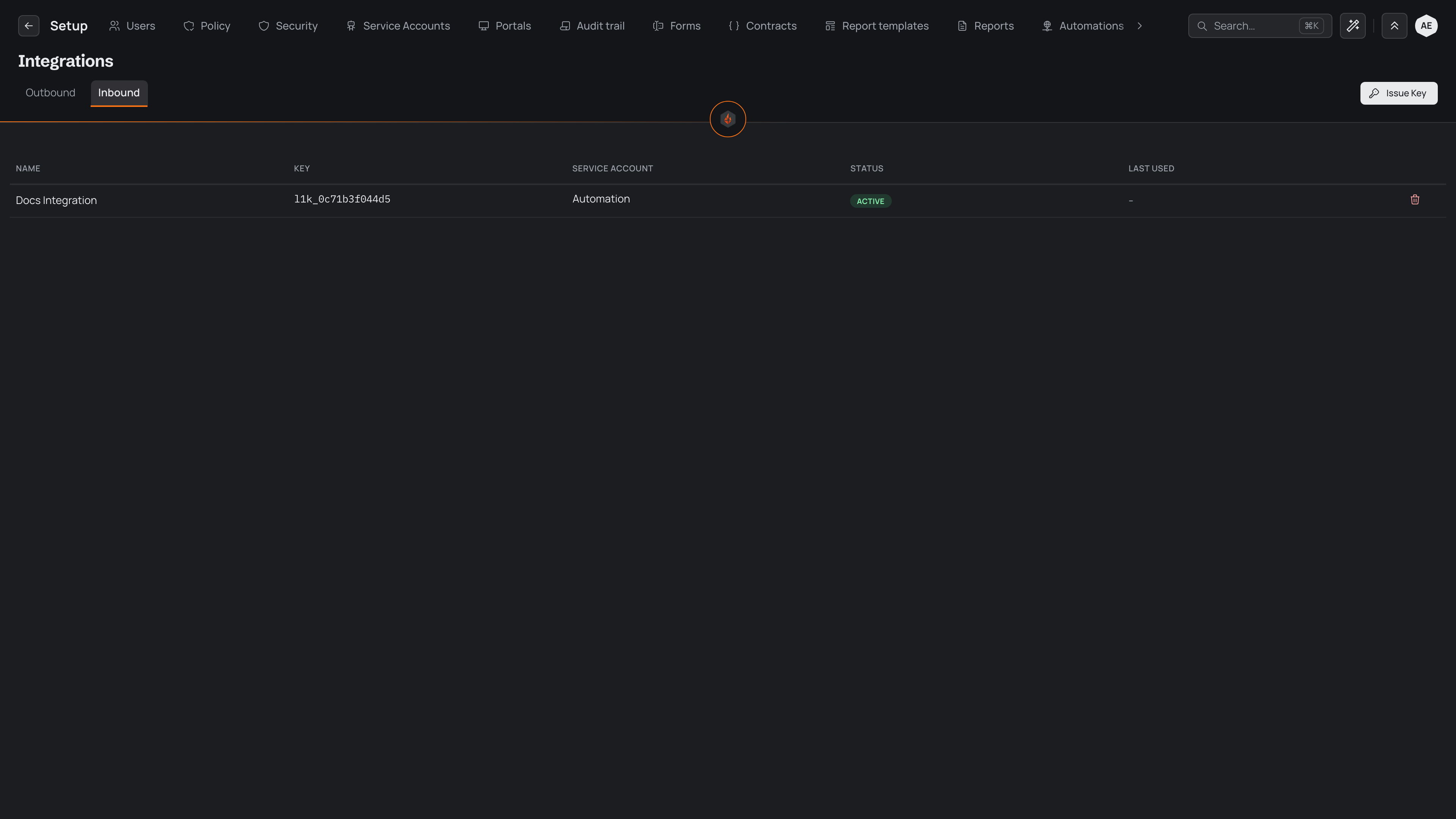
Each key you have issued appears in the list with its name, its public identifier — the part that starts l1k_ — the service account it acts as, its status, and when it last called in. The identifier is safe to share and to keep on hand; it names the key without being the secret that authorises it.
To issue a key:
- Select Issue Key.
- Choose the service account the key acts as. Every call made with the key runs as this account, and its roles set what the key can reach — so pick one whose access matches what the caller needs, and no more. If a suitable account does not exist, set one up first on the service accounts page.
- Give the key a name that says who or what will hold it — the partner, device, or script on the other end — so you can tell your keys apart later.
- Confirm. Pyron shows the full key one time, on screen. Copy it straight away and give it to the system that needs it.
The full key is the whole secret. Pyron stores a one-way hash of it to check callers against, and keeps the value itself nowhere — so no screen shows it a second time.
Scopes and expiry
A key holds no permissions of its own. Everything a caller can do with it comes from the service account the key acts as: that account's roles are the key's reach, in full. There is no separate per-key scope to tick — to widen or narrow what a key can do, change the roles on its service account, and every key acting as that account moves with it.
This keeps a key easy to reason about. Two keys pointed at the same service account have matching access; a key pointed at a tightly scoped account can touch only what that account can. Give each integration its own service account when it should hold its own slice of access, and its own key so you can cut off one caller without disturbing the rest.
A key stays valid from the moment you issue it until you revoke it — issuing sets no expiry date, so a key does not lapse on a schedule. Plan to rotate long-lived keys yourself: issue a replacement, move the caller across to it, then revoke the one it replaced. A key's status marks whether it is in force, and a caller that presents a revoked or lapsed key is turned away rather than let in.
Revoking
Revoke a key the moment it stops being needed, or if it might have leaked — a key written into a log file, committed to a code repository, or held by a partner you have parted ways with. Revoking cuts the key off at once: the next call that presents it is refused.
To revoke a key, find its row in the list and use the revoke control there. Pyron asks you to confirm and names the key, so you cannot cut off the wrong one by mistake. Confirm, and any system still holding that key stops getting in from that point.
Revoking is final for that key — there is no reversing it. A revoked key keeps its place in the list, marked as revoked, so the history of what was issued and withdrawn stays available to review. To restore access for the integration itself, issue it a new key and update the caller with that value.
Removing a service account revokes every key that acts as it in the same stroke. Retiring an integration in full, then, is a matter of removing its service account — its keys stop working with it.